Switching Pharmacies Safely: The Hidden Medication Risks Most Patients Never Consider
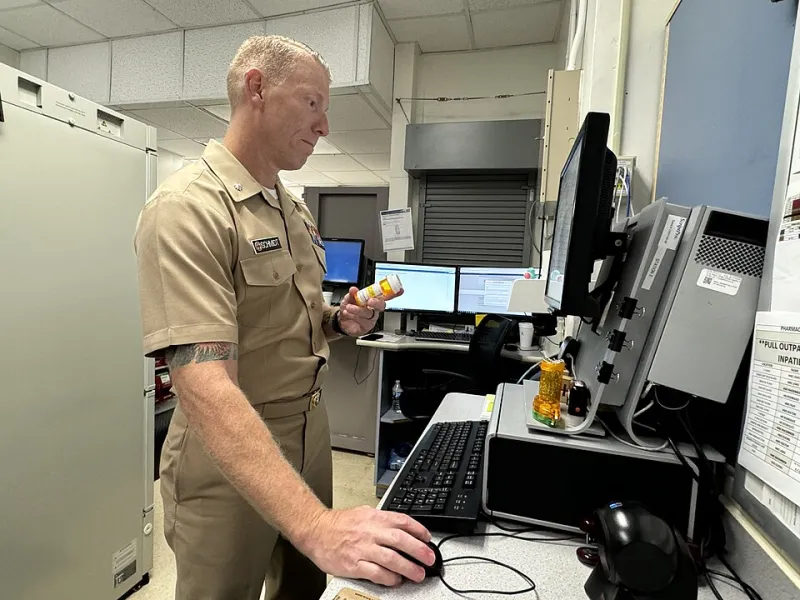
Photo: U.S. Navy NMRTC by Emily McCamy, Public domain, via Wikimedia Commons
For many Americans, the decision to move prescriptions from one pharmacy to another feels entirely unremarkable. Perhaps a new location offers a better price, a more convenient drive-through, or a mail-order option that fits a busy schedule. The transfer itself is often completed in minutes—a quick phone call, a signature, and the transaction appears finished.
What most patients do not realize is that the moment their prescription history moves between pharmacy systems, a critical layer of medication safety can quietly disappear.
The Invisible Safety Net You Didn't Know Existed
Modern pharmacies do far more than count pills and affix labels. Every time a licensed pharmacist processes a prescription, sophisticated software cross-references that medication against the patient's full drug profile stored in that pharmacy's system. These clinical decision support tools flag potentially dangerous drug interactions, alert pharmacists to duplicate therapies, and identify contraindications based on documented allergies or medical conditions.
The operative phrase, however, is that pharmacy's system. Pharmacy databases in the United States are not universally connected. When a patient transfers their prescriptions to a new location—whether across town or across the country—the receiving pharmacy begins with a blank slate. It sees only what has been explicitly transferred, and frequently that means a single prescription rather than a comprehensive medication history.
The result is a dangerous informational void. A new pharmacist processing what appears to be a routine refill has no way of knowing that the patient is also filling a blood thinner at a former pharmacy, or that a prescribing physician recently added a medication that carries a known interaction risk with the drug being dispensed.
When Incomplete Records Lead to Real Harm
Drug interaction errors are among the most preventable—and most underreported—adverse medication events in the country. The Institute for Safe Medication Practices has long documented cases in which patients were harmed not because a pharmacist failed to check for interactions, but because the information necessary to catch those interactions simply was not available at the point of dispensing.
Consider a common real-world scenario: a patient manages chronic pain with a prescription opioid filled at their primary pharmacy, and separately receives a new prescription for an antidepressant from a psychiatrist, which they fill at a different location for convenience. Neither pharmacist has visibility into the other's records. The combination of certain opioids and specific antidepressants can precipitate serotonin syndrome—a potentially fatal condition—yet without a unified medication profile, the warning that should have appeared never does.
Duplicate therapy is an equally serious concern. A patient who sees multiple specialists—a cardiologist, a primary care physician, and an endocrinologist, for example—may receive overlapping prescriptions for medications in the same drug class. When those prescriptions are filled at different pharmacies, no single system ever assembles the complete picture, and the duplication goes undetected.
Why the Transfer Process Itself Creates Gaps
The mechanics of a pharmacy transfer introduce additional vulnerabilities beyond the absence of a shared database. When patients initiate a transfer, they often communicate only the name of the medication they need moved. Allergy records, documented intolerances, clinical notes added by previous pharmacists, and the full list of concurrent medications are rarely part of what travels with a transferred prescription.
Furthermore, the receiving pharmacy's intake process may not prompt for a complete medication reconciliation. Staff may ask whether the patient has any known allergies, but a brief verbal exchange at a pickup counter is a poor substitute for a verified, pharmacist-reviewed medication profile.
In busy retail pharmacy environments, where pharmacists are often managing high prescription volumes, the assumption that a patient's history is available in the system can create a false sense of security—particularly when that assumption goes unexamined.
Step-by-Step: How to Transfer Prescriptions Without Compromising Your Safety
The good news is that the risks associated with pharmacy transfers are manageable, provided patients take an active role in the process. The following steps can significantly reduce the likelihood of a dangerous gap in medication oversight.
1. Compile a complete, current medication list before initiating any transfer. This list should include every prescription medication, over-the-counter drug, vitamin, and supplement you take regularly. Note the dose, frequency, and the prescribing provider for each item. Keep this document updated and bring it to every pharmacy interaction.
2. Request a printed copy of your full medication history from your current pharmacy. Pharmacies are required to provide this information upon request. A printed record gives the receiving pharmacy a foundation to work from rather than starting from zero.
3. Inform the new pharmacy of all medications you are currently taking—not just the ones being transferred. Do not assume that medications filled elsewhere are visible to the new location. Disclose everything, and explicitly ask the pharmacist to enter your full medication list into their system before processing any new prescriptions.
4. Alert your prescribing physicians to the change. Your doctors may be sending electronic prescriptions to your previous pharmacy. Updating their records ensures that future prescriptions route correctly and that your care team has an accurate picture of where your medications are being managed.
5. Ask the pharmacist to conduct a medication review. Many pharmacies offer medication therapy management services at no additional cost, particularly for patients managing multiple chronic conditions. A formal review with a licensed pharmacist is one of the most effective tools available for identifying interaction risks.
6. Consider consolidating all prescriptions at a single pharmacy. The safest medication management strategy remains filling all prescriptions—regardless of the prescribing physician—at one location. A unified pharmacy record is the most reliable safeguard against interaction errors and duplicate therapy.
The Role of Technology and What Still Falls Short
Some states have implemented prescription drug monitoring programs that create a partial record of controlled substance dispensing across pharmacy locations. While these programs are valuable tools for identifying misuse patterns, they were not designed as comprehensive medication safety databases and do not capture the full range of prescription drugs.
Several pharmacy chains have invested in proprietary systems that allow patients to fill prescriptions at any location within their network while maintaining a centralized record. This is a meaningful improvement, but it does not address the gaps that emerge when patients use multiple pharmacy organizations simultaneously—a common pattern in the United States.
Interoperability between pharmacy systems remains an evolving area of health information technology. Until standardized, nationwide data sharing becomes a reality, the burden of maintaining a complete medication record falls largely on patients and their healthcare providers.
A Word on Prescription Savings and Informed Decisions
At CureRx For, we understand that prescription costs are a genuine and pressing concern for millions of Americans. The search for lower prices is entirely reasonable, and there are legitimate ways to reduce what you pay for medications without compromising your safety. Comparing prices, exploring generic alternatives, and using verified prescription discount programs can all yield meaningful savings.
What we caution against is allowing the pursuit of a lower copay to become the sole driver of a pharmacy decision—particularly when the transfer is made without adequate attention to medication safety. The cost of an adverse drug event, whether measured in emergency room visits, hospitalizations, or worse, far exceeds any savings realized at the pharmacy counter.
Being an informed patient means understanding not just what your medications cost, but how they interact with one another—and ensuring that someone with the clinical expertise to catch a dangerous combination always has the information they need to do so.
Your health is not a transaction. Treat your pharmacy relationship with the same care you bring to choosing a physician, and the transitions you make along the way will be far safer for it.